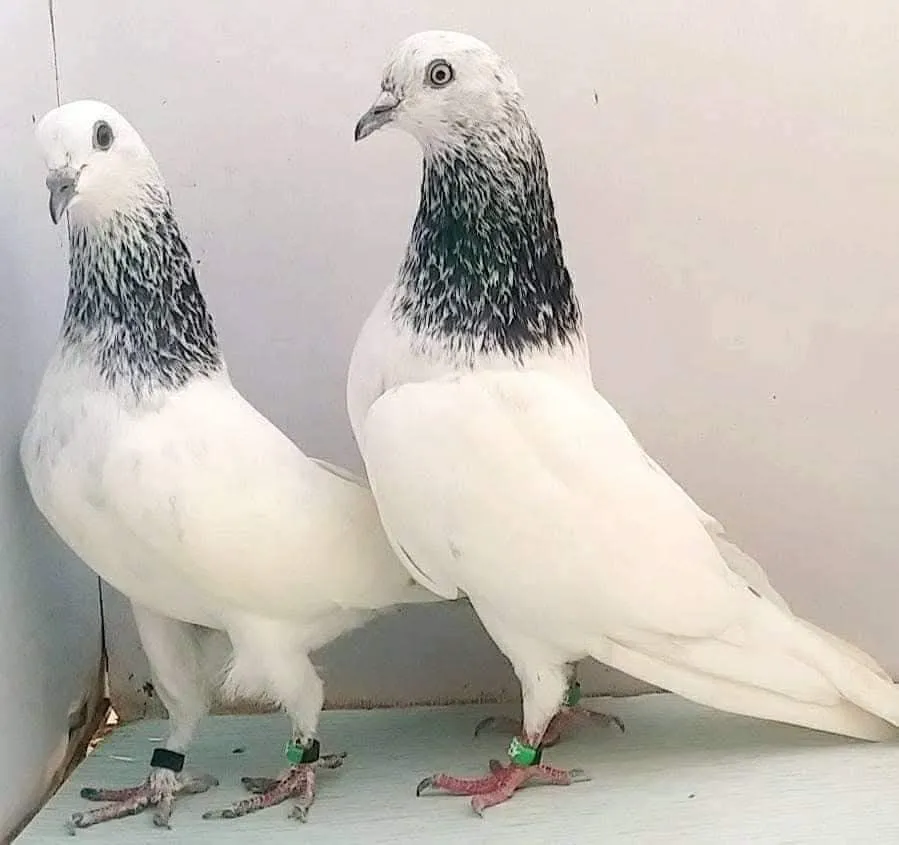
The Sialkoti Pigeon: A Royal Legacy of the Punjab
Few pigeon strains carry as much history, cultural weight, and genuine controversy as the Sialkoti. Named after the city of Sialkot — today in Pakistan's Punjab province — this strain has been the subject of endless debate among fanciers: Is it a Sialkoti pigeon, or a Jammu pigeon? The answer, it turns out, is both. And neither fully. It is, above all, a pigeon forged from the shared civilisation that existed on both banks of a border that did not yet exist.
"Jammu and Sialkot were the same. People had havelis on both sides of what is now the border. The pigeon-keeping tradition belonged to nawabs, jagirdars, and royal families — it didn't recognise a boundary."
— Dr. Ashish Gupta (Raji Doctor), Jammu
The city of Sialkot lies roughly 35 kilometres from Jammu — as little as 10–12 kilometres as the crow flies across the Suchetgarh border. Before 1947, people freely cycled or walked between the two towns. The pigeon collections of noble families were shared, gifted, and intermingled across this short distance so thoroughly that drawing a sharp line between a "Jammu" and a "Sialkoti" pigeon is, to this day, almost impossible.
Chapter I: Origins — A Royal Hobby Divided by History
The Sialkoti pigeon tradition is rooted in the hobbyist culture of the Dogra dynasty and the aristocratic families of the greater Punjab. Nawabs, jagirdars, and ruling-class families on both sides of what would become the India–Pakistan border maintained large lofts — some numbering in the thousands. Pigeon-keeping was not merely a pastime; it was a statement of refinement, wealth, and social standing.
The Partition of 1947 and Its Impact on the Strain
When India and Pakistan were partitioned in August 1947, the pigeon collections were among the countless things divided, lost, and scattered. Families fleeing across the newly drawn border could not always bring their birds. Some noble families, fearing they would not survive the journey, slaughtered their entire lofts rather than leave them behind. Others managed to carry a few birds with them, and it is from these scattered remnants that both the Pakistani and Indian lines of Sialkoti pigeons descend today.
The birds remaining in Jammu and the birds that made it to Sialkot both carry the same ancestral bloodlines. In Sialkot, wealthy patrons and pigeon enthusiasts nurtured and developed the strain vigorously — aided by Sialkot's emergence as a prosperous industrial and commercial hub. On the Indian side, Jammu fanciers preserved their own lines with equal care. The result is two parallel but closely related pools of what is essentially the same historical strain.
Key Historical Facts
- Sialkot and Jammu are only ~35 km apart; ~10–12 km by air — pigeon exchange between the two cities was continuous for centuries.
- The strain belonged to Dogra dynasty aristocrats, nawabs, and jagirdars of the greater Punjab.
- Post-1947, the strain survived on both sides of the border through dedicated fanciers who preserved remnant bloodlines.
- Sialkot grew into a major commercial and pigeon-breeding hub, giving the Pakistani branch of the strain wide recognition worldwide.
- The Indian side, centred in Jammu, maintains older bloodlines considered by some experts to be the original Dogra stock.
Chapter II: Environment, Climate, and the Sialkoti Flying Style
One of the most important principles stressed by old masters of the Sialkoti tradition is that pigeons are shaped by their environment. The circular, spiralling winds of the Sialkot–Jammu corridor — characterised by morning westward breezes and evening gusts — produced a pigeon that flies in wide, graceful arcs close to home, returning reliably at dusk. This is the hallmark shaam-shaam (evening flight) style: birds that rise and circle through the afternoon, building height and duration, and come home as the sun sets.
Some fanciers mistakenly claim that Sialkoti pigeons were bred specifically to control or herd other pigeons. Experts firmly reject this. The flying style is entirely a product of the local wind patterns, the flat-to-hilly terrain, and generations of selective breeding for endurance and homing ability. A Sialkoti pigeon released far from home will orient and return — its instinct, not its training, carries it back.
"The wind here moves in circular patterns. Pigeons evolved their flight style around this — not to control other birds, but because this is simply how birds fly well in this specific geography."
— Dr. Ashish Gupta
Because Sialkot is west of Jammu, winds typically carry pigeons eastward toward the Indian side. Historical accounts from Jammu fanciers describe birds arriving from Pakistan's lofts after storms — and Jammu birds disappearing westward across the border. This constant, natural exchange contributed to the genetic richness of both populations.
Chapter III: Physical Characteristics
The Sialkoti is not a single uniform-looking bird — it encompasses several sub-varieties and colour patterns. However, certain traits are consistent across the finest specimens and are used by experts to authenticate lineage.
Body Structure
The ideal Sialkoti pigeon is compact and lightweight, with a broad chest, a neat, tight body, and a carriage that experts describe as banka — upright, confident, chest-forward, and sleek. The neck is slender and elegant. Birds that are overly heavy or loose-bodied are considered off-type. The wings should be tight against the body, with the primary flight feathers (the kund) neatly aligned. A slight match of secondary and tertiary feathers — sometimes called mel — is considered a positive hereditary marker.
Eye Colour — The Most Critical Marker
Among all physical traits, eye colour is considered the single most important indicator of purity and quality in the Sialkoti tradition. A complex vocabulary has developed over centuries to describe the spectrum of acceptable eye colours. Breeders spend years developing their eye to read these subtle distinctions, which directly inform breeding decisions.
The traditional eye-colour vocabulary, from purest to lightest, is as follows:
- Pathar (Stone) — Near-black; the purest and rarest eye colour. The gold standard of authenticity.
- Kali (Dark) — Very dark grey; considered the highest quality after Pathar.
- Maili — Dark with a dusky, slightly muted quality.
- Gubbari — Lighter than Maili; a noticeable step down in perceived purity.
- Grey / Blue-Grey — Acceptable in certain lines; common in some cross-bred descendants.
- Shisham / White — An older traditional eye type found in some white-variety Sialkotis.
The deepest, darkest eyes — pathar and near-black — are considered the gold standard of purity. These eyes are said to intensify with age in quality birds, and young squabs with already-dark eyes are prized above all others. A bird's eye in sunlight versus shade can appear different; experienced fanciers account for this when evaluating.
Critically, eye colour is not determined by ring patterns, iris markings, or pupil size alone — these are considered red herrings by master breeders. True quality is in the depth and darkness of the overall iris colour, which reflects generations of pure breeding.
Chapter IV: Principal Sub-Varieties of the Sialkoti Strain
The Sialkoti strain is not a single fixed variety but a broader family of closely related types, all sharing the same regional heritage and flight tradition. The following are the main varieties historically recognised by fanciers of the region.
Chhat Wala (Roof Pigeon)
One of the most celebrated local types, the Chhat Wala comes in three distinct patterns: the white-winged deep-coloured bird, the churi-chaate type with a distinctive head marking, and the kanya kali (black-crowned) variety. These birds trace their lineage to the royal family of Sangrur in Punjab. Breeders differentiate the true Chhat Wala from impostors by its specific body proportion and eye colour — anything else is considered a mixed derivative.
Chuha (Mouse Pigeon)
Originally called Juhi — after a small fragrant flower — this compact, rounded bird was renamed "Chuha" over time due to its small, nimble appearance. It is entirely a local Jammu–Sialkot type, with no foreign origin. Several sub-varieties exist: the motiyaan wala (pearly-marked), the gitthu (small), and the larger standard Chuha. When crossed with Chandakhani blood, the resulting birds have been considered outstanding.
Sheikhon Wala
A deeper-coloured, richly feathered variety known for extraordinarily pure dark eyes. The original Sheikhon Wala came in two colour patterns: a red-patterned (lal pari) type and a black-faced (kale munh wala) type. The Sheikhon Wala's eyes, when maintained in pure lineage, are described as resembling the eye of an eagle — deep and amber-brown with exceptional clarity. A third variant, the kalsra-kalpotia (dark-chested, dark-tailed), is also recognised.
Batair (Quail Pigeon)
The Batair is the archetypal Sialkoti highflier — a speckled or fawn-mottled bird with a compact body optimised for endurance flight. When a Batair of Chhat Wala lineage is produced, it is considered a particularly valuable bird. The Batair tends toward faded or mottled colouring, with deeper, richer individuals considered superior within the type.
Ali Wala
A noble sub-type historically associated with high-pedigree Sialkoti families. The Ali Wala is recognised for its aristocratic carriage and particularly consistent eye quality. Like many Sialkoti varieties, its exact genealogy was held closely by the families who bred it, and reliable examples are rare today.
Safaid (White Varieties)
The white Sialkoti pigeons form their own complex family. Historically, six distinct white varieties were recognised, including the Sambhal Wale (from Sambhal), the Tare (star-marked), and the celebrated Kainaat — considered by old fanciers to be among the greatest highfliers ever produced, famous for evening flights and extreme sensitivity to handling. The Benazir Begum Mahal variety — named after a Lucknow queen — is also part of this white family.
Chapter V: Breeding Philosophy and the Master Fancier's Art
The Sialkoti tradition places enormous value on the knowledge of the ustad — the master fancier. A true ustad, in this tradition, is not merely someone who owns fine birds. The test of mastery is the ability to look at a pair of birds and predict, with reasonable certainty, what their offspring will look like, how they will fly, and whether they are suited for competition. This predictive skill, honed over decades, is the heart of the craft.
Bloodline Management
Sialkoti breeders are acutely aware of the dangers of inbreeding — a line kept too pure for too long weakens in constitution and flying ability. The practice of introducing "touches" (pur dalna) — crossing a pure line with a carefully chosen bird of another compatible strain — is standard. The skill lies in choosing the right cross at the right moment, and then back-selecting the offspring to return to the desired type. A bad cross introduced carelessly can destroy generations of refined breeding.
The Role of Natural Crossings
Given the proximity of Sialkot and Jammu, and the centuries of birds flying across the border in both directions, a degree of natural genetic exchange has always occurred. Expert breeders acknowledge that some of the finest birds in the historical record were likely the products of accidental or natural crossings — birds that landed in an unfamiliar loft and were paired with the resident stock. Far from being a source of contamination, these kudratu jore (natural pairings) are spoken of with reverence.
"A true master looks at a pair and tells you what their children will be — how they'll fly, what they'll look like. Anyone can buy a pigeon. Only a few can read a pair."
— Dr. Ashish Gupta
Warnings Against Advertising-Driven Purchases
A recurring theme among veteran Sialkoti fanciers is a strong caution against purchasing birds based on social media hype or market advertisements. Experienced masters point out that when a particular name or strain becomes heavily marketed, prices inflate far beyond the birds' actual quality. Many celebrated strains that were briefly hyped on YouTube and Facebook have since disappeared or deteriorated.
The advice universally given is: invest in fewer birds of genuine, traceable lineage; work with what you have through patient, careful breeding; seek guidance from established masters with multi-generational experience; and never spend beyond your means chasing fashionable names.
Chapter VI: The Bajiya Tradition — Flight Competitions
The Sialkoti pigeon exists fundamentally in the context of the bajiya (flight competition or wager). Unlike purely ornamental breeds judged in shows, the Sialkoti is a working flier — its value is measured in endurance, homing instinct, and the ability to outlast competing birds in the sky.
Traditional Sialkoti-area competitions were conducted on a last pigeon basis: the owner whose bird was last to land or last to return home in failing light was declared the winner. These evening competitions — held in the warm afternoons of summer and autumn — could extend across multiple days, with the stake carried forward if no bird returned before dark.
The UP (Uttar Pradesh) tradition, which heavily influenced Jammu and Sialkot flying culture, measured flights in hours: competitions of 3.5 hours, 7 hours, and longer were recorded. The all-India cup circuit, legendary among old fanciers, was dominated for decades by masters from this tradition. The Sahranpuri, Rampur, and Firozpuri strains all interacted with and influenced the Sialkoti flying tradition.
Feeding Practices for Competition
Old masters of the tradition were meticulous about competition-day feeding. One documented practice involved adding small amounts of lal mirch (red chilli) to the grain — believed to keep birds in a heightened, alert state that extended their aerial endurance. Feed quantities were deliberately restricted on competition days so birds would fly lean and return sharp. These methods, passed down through personal instruction rather than written manuals, are rarely known outside traditional practitioner circles.
Chapter VII: The Challenge of Preservation Today
The authentic Sialkoti strains — particularly the rarer sub-varieties such as the original Chhat Wala, the pure Kainaat whites, and the pathar-eyed Sheikhon Wala — are under serious pressure. Several factors have contributed to their decline.
The social media era, while bringing wider awareness to the hobby, has also introduced a market-driven mentality that rewards visible novelty over depth of breeding. Fanciers chase famous names and pay inflated prices for birds of dubious lineage. The knowledge required to authenticate a Sialkoti bird — reading eye colour, assessing body type, understanding the pedigree of a pair — is held by a dwindling number of elders.
Many original families of breeders in both Jammu and Sialkot are no longer active. Their birds were dispersed, sold, or lost. What remains are fragments — scattered birds with partial bloodlines, in the hands of a relatively small number of dedicated preservationists who have the knowledge and commitment to maintain authentic stock.
Preservation Priorities
- Prioritise birds with documented multi-generational pedigree from known traditional families.
- Eye colour quality — particularly the pathar (stone) and deep kali eyes — should be the primary selection criterion.
- Avoid purchasing based on price or internet hype; seek guidance from experienced, traditional fanciers.
- Maintain records: note which pairs produced which results, and across how many generations.
- Occasional careful crosses with verified Rampur, Chandakhani, or related stock can refresh a flagging line — but must be done with knowledge, not at random.
Chapter VIII: Related and Companion Strains
The Sialkoti pigeon does not exist in isolation. It belongs to a broader ecosystem of North Indian and Pakistani pigeon strains that share historical ties, have influenced one another through crossing, and are often kept alongside Sialkotis by serious fanciers.
Rampuri
From Rampur, UP — arguably the most influential strain in North Indian pigeon culture. The Teddy, Golden, and other widely bred variants all derive from Rampuri stock. A high-quality Rampuri cross with a Sialkoti can produce outstanding results; this is one of the most respected combinations in the tradition.
Firozpuri
From Ferozepur, Punjab. A robust, well-known highflier that has historically overlapped and interacted with Sialkoti stock. Some birds presented as "Firozpuri" today are in fact Sialkoti derivatives or crosses — a source of confusion and, occasionally, deliberate misrepresentation in the market.
Shahjahanpuri / Hara (Green) Pigeon
The Hara (green-iridescent) pigeons of the tradition, including the Shahjahanpuri variety, are renowned for extreme evening flight endurance. Some masters consider the pure Hara the last and greatest bird of a day's flying session. At least 19 varieties of Hara breeding are recognised in the tradition.
Chandakhani
A dark-eyed, powerful strain widely used in crossing work. Chandakhani crosses with Chuha pigeons have historically produced birds of exceptional quality. Also noted for their role in developing the deep-eyed Baanke type when crossed with older bloodlines.
A Living Tradition
The Sialkoti pigeon is more than a breed — it is a testament to centuries of shared culture across what is now an international border. Its survival depends on the few who still possess the knowledge to recognise, breed, and fly these birds in the spirit of the tradition. To keep a genuine Sialkoti is to hold a fragment of a civilisation.