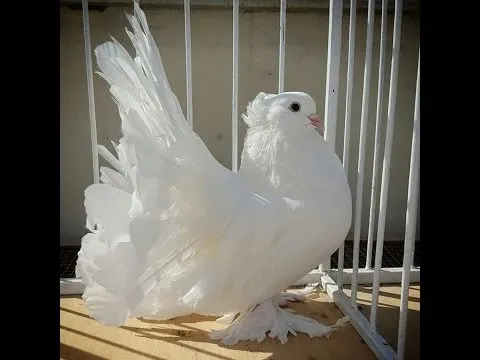
The Lakka is a bird of royalty. Historically, they were kept as "living jewels" in palace gardens. Unlike the flying strains we've discussed (like the Nokra or Sabja), the Lakka was bred specifically for its spectacular tail structure and its unique, vibrating movement.
In Nepal, the Lakka is highly prized for its "Dancing" ability. It is a very social bird and is often used to bring a sense of life and motion to a loft. While it cannot fly high or long, its value in the market often rivals or exceeds that of the high-flyers, depending on the "count" and "quality" of its tail feathers.
🏗️ Physical Identification (The Show Standard)
- The Tail (The Fan): This is the Lakka's defining feature. A standard pigeon has 12 tail feathers; a high-quality Lakka should have 30 to 40+ feathers. The tail must be carried upright and spread in a perfect, circular fan shape, like a peacock.
- The "Action" (Vibration): A pure Lakka doesn't just sit still. It has a characteristic "tremble" or vibration in its neck and body when it is excited or displaying. This "shaking" is the mark of a bird with high ornamental blood.
- The Stance: They have an extreme "S-shaped" posture. The chest is pushed forward and upward, while the head is thrown back so far that it often touches the tail.
- The Feet: Unlike the flying strains, pure Lakkas often have "Muffs" (feathers on their feet), though "clean-legged" varieties also exist.
- Color Varieties:
- Safed (White): The most popular and traditional color.
- Lal (Red/Brown) and Kaala (Black): Highly prized for their contrast.
- Patti-Wala: White bodies with colored patches.
🚀 Role in the Professional Loft
- The "Atmosphere" Bird: Lakkas are kept to add aesthetic value. They make the loft look "complete" and prestigious.
- The "Tamer": Because Lakkas are naturally calm and don't fly away, they are often used to calm down nervous high-flying strains. If a new, wild-caught bird is brought into the loft, being around the grounded, peaceful Lakkas helps it settle in.
- The "Ground Ornament": Since they are poor flyers due to their heavy tails and extreme posture, they spend most of their time on the loft floor or low perches, acting as "living decor."
🧬 Genetic Legacy & Value
The Lakka is a "Closed Line" strain. Breeders never cross Lakkas with high-flying strains like Nokras or Sabjas because it would ruin both the flight of the flyer and the tail of the Lakka. In Nepal, the value of a Lakka is determined by:
- Tail Count: The more feathers, the higher the price.
- Peak: The tail should be flat and circular, not "funnel-shaped."
- Head Position: The head must rest comfortably on the cushion of the tail.