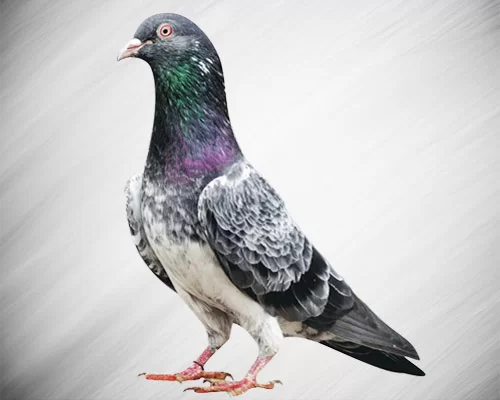
The Kasuri Pigeon (also known as Qasoori) is considered the "Mother Breed" of many high-flying strains in Pakistan. While the Teddy strain is a specific offshoot, "Kasuri" refers to a broader, ancient lineage originating from the same region, known for producing some of the most heat-resistant and long-endurance flyers in the world.
1. Origin and History
As the name suggests, this breed originated in Kasur, Pakistan. It is one of the oldest established high-flyer lineages in the Indian subcontinent.
The Foundation: Unlike the Teddy, which was a specific 1960s creation, the Kasuri line dates back much further. It is the root from which many modern sub-strains like the Kamagar, Golden, and Dab Walay were developed.
Key Figures: While many families contributed, Ustad Mian Nazeer (Late) of Lilyani, Kasur, is perhaps the most iconic figure associated with refining Kasuri bloodlines. He is credited with perfecting the crosses that allow these birds to fly in the brutal 45°C–50°C summers of Punjab.
Evolution: The Kasuri was traditionally bred for "Pigeon Bazi" (competitive flying) where the bird must remain in the sky from dawn until dusk.
2. Key Physical Features
The Kasuri has a very distinct "look" that separates it from the Sialkoti or purely white-eyed breeds.
- The Eyes (Red/Orange): This is the biggest distinction. A pure Kasuri traditionally has red, orange, or yellowish-red eyes. The iris is usually very deep in color, which fanciers believe helps the bird filter the harsh glare of the sun at high altitudes.
- The Beak and Face: They often have a black beak and a slightly broader, more "masculine" head compared to the sleeker Teddy. The face is expressive and tough.
- Feet and Nails: They almost always possess dark or black nails and reddish-pink feet. The scales on the legs are often very dry, which is a sign of a "desert-hardy" bird.
- Feather Patterns: Kasuri pigeons are much more diverse in color than Teddys:
Neelay (Blue-ish): Greyish-blue with dark bars.
- Golden: A brownish-yellow tint on the feathers.
- Dab Walay: White-bodied with patches or "dabs" of color on the head or wings.
- Kamagar: Darker patterns, often considered the "powerhouse" of the Kasuri line.
3. Performance and Flying Distinctions
Kasuri pigeons are the "marathon runners" of the pigeon world.
- Heat Tolerance: Their primary distinction is their ability to fly in extreme heat. While other breeds might descend when temperatures hit 42°C, a pure Kasuri is often just hitting its stride.
- Endurance: In peak competition (Jeth/June season), Kasuri pigeons are expected to fly for 12 to 18 hours. It is not uncommon for a champion Kasuri to land after sunset.
Altitude: They are "high-flyers" (Buland Parwaz). They typically go "out of sight" (Zarra) within the first 30 minutes and stay at that altitude for the duration of the flight.
- Homing Ability: Because they fly so high and for so long, they have an evolved internal compass. They are famous for "dropping" straight onto their own roof even when exhausted.
4. Distinctions from Other Strains
| Feature | Kasuri (Standard) | Teddy (Kasuri Offshoot) | Sialkoti (Ali Walay) |
|---|---|---|---|
| Eye Color | Red / Orange | Pure White | White with a Red Ring |
| Heat Resistance | Highest in the world | Very High | High (but prefers cooler air) |
| Body Size | Medium / Solid | Small / Compact | Sleek / Long |
| Feathering | Often colorful/barred | Usually white/black tips | Often "35-wala" (Greyish) |
5. Summary for Archivists
When recording data for Kasuri pigeons, it is important to distinguish between the broad category and the specific sub-strains.
- If a bird has red eyes and a black beak from the Kasur region, it is classified as a Kasuri.
- If it has white eyes, it is likely a Teddy (which is technically a "White-Eyed Kasuri" but is now treated as its own separate strain due to its fame).
- For your spreadsheet calculations, the Kasuri is the benchmark for thermal endurance (flight time vs. temperature).