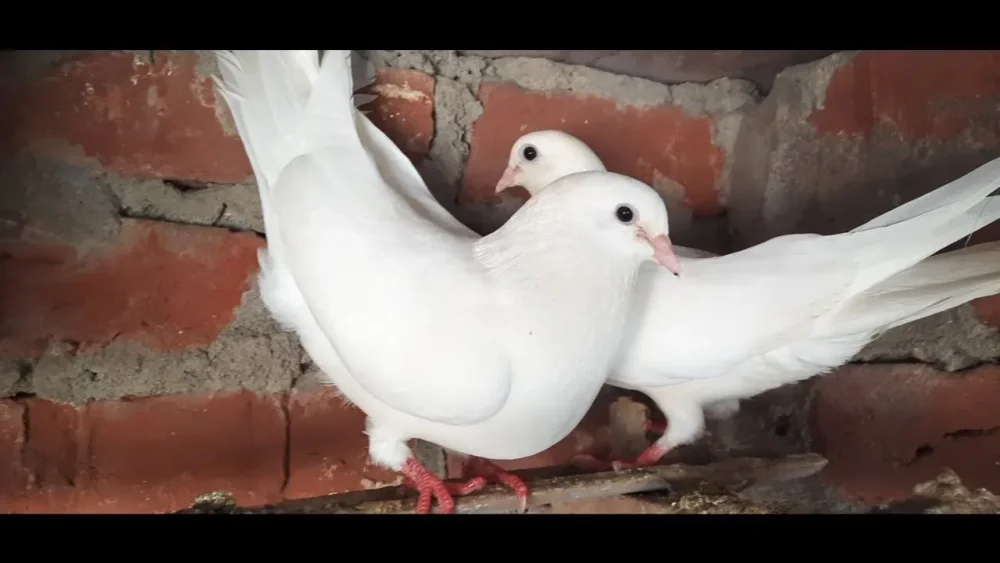
The Kagji holds a special place in Nepali culture as the "aristocrat" of the loft. While most Nepali strains are selected purely for their ability to fly 12+ hours, the Kagji is often bred for its perfection of form. In the Kathmandu Valley, a "Shuddh" (Pure) Kagji is a bird of beauty, often kept by fanciers who appreciate the traditional "Paper-White" look.
Because they have been bred for appearance for generations, many Kagji lines have lost the extreme stamina required for major tournaments. However, a small percentage of breeders still maintain "Flying Kagji" lines, which are prized because they are much harder to produce—balancing that specific ornamental look with the heart of a high-flyer.
🏗️ Physical Identification (Standard of Purity)
- The Eyes (The Beauty Marker): The defining feature is the Deep Black Eye (Kaali Aankh). In ornamental circles, the eye must be perfectly round and solid black, with no "leakage" of other colors in the iris.
- The Plumage: Immaculate White. Unlike the working strains (like Kafra or Sabja), an ornamental Kagji is expected to be "spotless." The feathers are often softer and more "silky" than those of the hard-flying strains.
- Beak and Nails: Must be Clear White/Ivory. Any "Siyah" (black) on the beak significantly reduces the bird's value as an ornamental specimen.
- Stance: The Kagji is known for its graceful "stand." It carries itself with a certain elegance, often looking more "upright" on its perch compared to the rugged, horizontal stance of the endurance flyers.
🚀 Flight Performance (The "Flying" Minority)
- Short-to-Medium Duration: Most Kagjis are "low-time" birds, flying for 3 to 5 hours. They are often used as "show" birds or to lead the kit back to the loft.
- The "Udaan" Kagji: Those rare Kagjis bred for performance are highly respected. They retain the black eyes but have the "hard" wing structure of a high-flyer. These birds are usually "crossed" with endurance blood but selected to keep the Kagji appearance.
- The "Dropper" Role: Because of their calm nature and high visibility, Kagjis are frequently used as "Droppers" (Saathi). Their bright white wings and steady flight help guide the high-altitude champions (who may be miles up in the blue) back down to the roof safely.
🧬 Genetic Legacy & Value
The Kagji is the "Beauty Component" of the Nepali pigeon gene pool. Breeders who find their lofts looking too "rugged" or "mixed" will bring in a Kagji to restore the classic white look and the calm "black-eyed" temperament. In the market, a Kagji’s value is determined by its purity of white and the depth of its black eye, rather than its flight log.