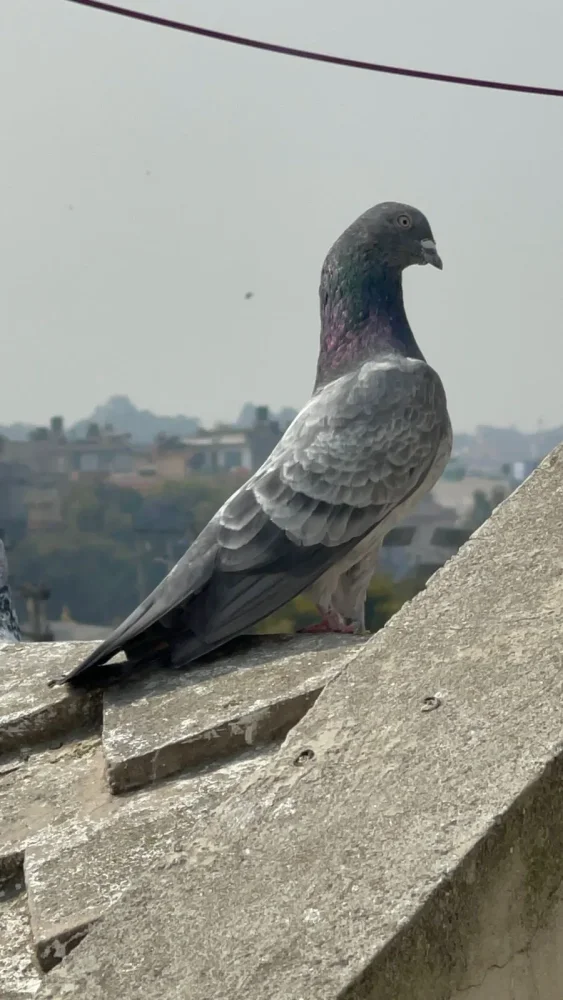
The Kafra is a traditional Nepali strain that is highly prized in both the Kathmandu Valley and the southern Terai regions. The name "Kafra" describes its unique plumage—a heavily mottled or "broken" color pattern that resembles a sprinkle of dark seeds or spices on a white base.
Historically, the Kafra was developed by breeders who needed a bird with a "harder" constitution than the delicate Kagji. Because of their slightly heavier feathering and robust bone structure, they are the preferred choice for flying in the "Windy Season." In Nepal, when the pre-monsoon gusts pick up, the Kafra is often the only bird that can maintain its position over the loft without being swept away toward the mountains.
🏗️ Physical Identification (Standard of Purity)
- The "Kafra" Pattern: The signature look of this strain is its mottled or "spiced" plumage. The bird is primarily white, but its body (especially the neck, shoulders, and chest) is covered in dense, small black or dark-grey spots. Unlike the "Chitla" patterns seen in Indian birds, the Kafra's spotting often looks more "irregular" and rugged.
- The Eyes: A pure Nepali Kafra typically features Pearl-White or Glassy Eyes (Safed Aankh). However, because they are a "harder" strain, you will often find a very distinct Dark Outer Ring (the circle of correlation) around the iris, which breeders believe signifies high physical stamina.
- Beak and Nails: They almost always possess Black (Siyah) beaks and nails. The beak is often slightly thicker and stronger than that of the Kagji, reflecting the strain's overall "tough" anatomy.
- Body Frame: They have a broad chest and a very strong "wing-butt" (the muscle where the wing meets the body). When held, a Kafra feels more muscular and "grippy" than other Nepali strains.
🚀 Flight Performance & Style
- Power over Grace: The Kafra does not have the "light" rowing flight of the Sialkoti; instead, it has a powerful, aggressive wing beat. This makes it a specialist at "cutting" through headwinds.
- Low-Light Reliability: Many Nepali Ustads observe that the Kafra is exceptionally good at flying during overcast days or in the hazy "dust-light" of the Terai. Their dark-spotted camouflage and strong eyes allow them to navigate when visibility is less than perfect.
- Medium-to-High Depth: While they certainly reach "Point-View" heights, they are often used as "mid-depth" flyers to keep the kit together. They are the "enforcers" of the kit, keeping the younger birds focused.
🧬 Genetic Legacy & Value
In the Nepali breeding system, the Kafra is the "Muscle." If a breeder’s line is becoming too "thin" or "weak-winged," they introduce Kafra blood. This cross-breeding adds weight, bone density, and wind resistance. A common and highly successful cross is the Kafra x Sabja, which produces a bird with elite endurance and the physical strength to finish a flight even if the weather turns sour.